
Checkpoints: Space is no longer a sanctuary
Gen. Saltzman on defending America's orbital assets
Russia and China are turning space into a battlefield, Chief of Space Operations Gen. B. Chance Saltzman warns, and the U.S. Space Force is racing to stay ahead. From lasers that blind satellites to spacecraft designed as orbital battering rams, America’s adversaries have transformed the final frontier into tomorrow’s most dangerous warfighting domain. It’s a domain where losing means going deaf, blind and defenseless all at once.
As Gen. Saltzman leads the defense of this ultimate high ground, commanding nearly 15,000 guardians in a space arms race, the stakes couldn’t be higher. For Air Force Academy cadets and graduates raised on dreams of space exploration, Gen. Saltzman offers a stark new mission: protecting the invisible infrastructure that powers modern life. Every drone strike, credit card swipe and emergency call depends on satellites silently circling overhead. Each one has a target on its back. The Checkpoints team sat down with Gen. Saltzman, a Boston University graduate, at his office in the Pentagon on Oct. 6, for a Q&A. The following is a lightly edited transcript of that conversation.
You’ve spoken about adversaries investing heavily to close the gap with U.S. space capabilities. How has the threat landscape in space evolved since you became CSO in November 2022?
In a word, the threat landscape since I took over as CSO has advanced dramatically. “Dramatic” is the word. The PRC [People’s Republic of China], for example, has invested in what I’ve described as all six categories of counter-space weapons. There are three types of weapons that can be executed from space, three from the ground, and those are the same three. It’s kinetic capabilities like missiles; it’s RF [radio frequency] energy, RF jamming; and it’s directed energy. The scale and the speed with which the PRC has put together a pretty vast array of weapons has been amazing. Not to be outdone, the Russians, of course, are also investing heavily in everything from direct-ascent ASATs, which they demonstrated right before the invasion of Ukraine, and also on orbit capability to try to deny us our access to space, and now even the idea of putting a nuclear weapon into orbit. So these are all fairly dramatic and have all kind of taken place since I took over as CSO.
What evidence have you seen over the past five and a half years that space is linked to modern warfare?
Well, you don’t have to look too much further than the Russian invasion of Ukraine. The idea that space is critical to the modern battlefield, I think, was evident from the beginning of that war. One of the first attacks was a ground network attack, a cyberattack against the ground network associated with the Viasat satellite communications. And it had a good effect for the Russians. I think we also saw that when that happened, the Ukrainians turned to a proliferated low-Earth orbit satellite communications constellation provided by SpaceX and Starlink. So we’re seeing that you can’t live without space; you can’t live without satellite communications; you can’t control forces if you don’t have those kinds of capabilities. The Russians knew this, and so they tried to dismantle it in Ukraine. But the United States has come to recognize its advantages in space, whether it’s satellite communications or global precision that the GPS constellation provides for strikes, et cetera, as well as the ISR capabilities, intelligence, surveillance, reconnaissance, weather. It’s just become an indispensable force multiplier for the joint force and any modern warfare is going to be heavily dependent on space capabilities.
What’s your vision for the way industry and the Space Force will continue to expand and improve their relationship?
The relationship the Space Force has with industry is a critical dependency, quite frankly. We can’t do our job if they don’t deliver high-end technology that we need to be successful. In the past, though, it’s been kind of transactional. It’s been us deciding what we want, trying to write requirements and then engaging industry to see if they can meet those requirements. And while that served its purpose in the past, that’s not producing the kind of innovation we need at scale fast enough. And so what I want to do is engage industry in a more collaborative relationship, not as much transactional. I need them involved in the innovation. I need their ideas generated before they see requirements. I need them to come to us with what is the art of the possible, not just what we might think we need in any given time and place. And so that’s a different relationship. I want to involve them from the beginning in our force design. I want to involve them in war games. I want to involve them in our tabletop exercises so they can see firsthand what the operational challenges are and bring their best ideas, their innovative ideas, their new engineering and technology to bear on our problems.
What are the biggest opportunities for the Space Force?
All of our challenges are opportunities. It’s easy to list the challenges sometimes, but our opportunities are quite frankly centered around the fact that the joint force understands how critical space is to how they do their jobs. And that presents an opportunity. As missions continue to be given to the Space Force, as we migrate more and more missions from land, air and sea up into space, these are tremendous opportunities for us to continue to integrate, continue to provide the joint force what they need to be successful. We’re going to have to be able to achieve some level of space superiority, control the domain, protect what we have, deny the adversary their use of space. These are all opportunities for us to hone our craft, to train [and] educate our personnel so they understand exactly how they contribute to the joint force. It offers opportunities to pull new technologies into, missions that haven’t been done from space before that will need to be done from space for survivability and scale. These are all tremendous opportunities to grow our resources, grow our personnel and contribute to the joint force.
You’re known as the father of multi-domain operations. How should future officers prepare to think across domains rather than in silos?
Yeah, the father of multi-domain operations — I may never escape that. It’s really quite simple, and we’ve talked about combined arms for decades. Success on the military battlefield comes more easily to those that are able to combine different types of effects, different types of warfare, all together to achieve a common goal. And we called that combined arms. Now we call it multi-domain arms, or alldomain arms. But it’s the same concept. You need to create multiple dilemmas for an adversary, have multiple attack vectors coming so the enemy doesn’t know where you’re going to create effects from. And the more vectors you have, the more problems for the adversary. The difference is that where we used to kind of rely on air, land and sea, now we’ve had to expand those concepts into cyber and space. Those are new warfighting domains. And we need to build the technologies, the systems. We need to train our personnel to be able to take advantage of those things. And I mentioned that the joint force will rely heavily on space and cyber, but cyber will also rely heavily on air, land and sea to continue to produce the kind of effects that we need. And so we have to build an officer corps, for example, that understands all of these domains, is able to integrate effectively, and understands where they fit and how others can contribute and create the kind of synergies that you get out of all domain operations.
What advice might you have for USAFA cadets interested in serving in the Space Force?
Study hard. You’re going to join a force that’s highly technical. We need to have the technical skills, but that’s not enough. I think that’s necessary, but not sufficient. Yes, I want you to study hard. Yes, I want you to be technically proficient, but I need you to be thinkers. I need you to be leaders. Because it’s more profound of a challenge to introduce and integrate these capabilities into a joint force. It’s not enough to just simply understand how the technology works. You have to understand how the force operates. And we need leaders. We need leaders who can translate and communicate these highly technical capabilities into meaningful strategies that our decision-makers can understand. And so leadership, communication, critical thinking skills, maybe some of the softer sciences associated with those are just as important. And so take advantage of your time in your commissioning source to practice leadership, to practice communications, to practice all of those soft skills, because we’re going to need them when you get to the force.
What guiding principles do you follow as the chief of space operations?
That’s an interesting one. I never really sought to develop a specific leadership style. I just simply try to address challenges that come up [and] solve problems that arise. And so being asked, “What are the guiding principles that you adhere to,” does seem a little odd, but a couple of things come to mind. One is, first, clearly understanding how I, in the position I’m in, add value to the organization. And if you don’t know how you add value to the organization, you need to do some introspection, because that’s what the organization expects [from] every one of us: to add value. And you have to know what your skills and experience can contribute as you add value. But more importantly for me, I think it’s that I only do what only the CSO can do. Meaning, if I’m trying to do other people’s jobs, then somebody is not doing mine. And so what is it that I uniquely provide, then focus on those things. And I think that boils down to really working hard to establish clarity. And that’s easier said than done. But clarity in our vision; clarity in the processes and the products that we need to produce as a service; clarity in guidance; clarity in my intent; clarity in how the Space Force adds value to the joint force; clarity in how the Space Force adds value to the United States in national security. And working hard so that we clearly articulate those kinds of values, I think, is important. And then keep those in mind as we make all the decisions that come with being in a service. And so those guiding principles are about clear-eyed focus on our priorities. What is it that only I can do? And make the kind of decisions that support the advancement of the force based on those principles.
Standing up a military service is no easy task. What have been some of the greatest challenges and some of the greatest opportunities?
It’s been such a remarkable journey. And of course there are challenges. It was the first time we established a service in almost 75 years. Everybody that knew how to establish a service is long gone, and so to some degree we were starting from scratch. But quickly I came to realize that there’s no way to accelerate the establishment of experience. I ask people, “How long does it take to develop a 15-year lieutenant colonel?” And the answer, no matter how fast you want to go, is [that it] takes 15 years to acquire that level of experience and wisdom. I can’t really accelerate that, but the Department of Defense requires highly experienced personnel to do the work that’s required. So it’s been a challenge. We’ve had to take younger people and step them up to more senior responsibilities. I’ve just been really proud of how we’ve responded to that. But that’s been a challenge — to make sure we put the right experienced personnel into the right positions, as small as we’ve been.
But we’re getting better, we’re getting faster. And the second major challenge that I think about is that we describe ourselves as the invisible front line. To some degree, space is out of sight and out of mind. And so connecting with the American people and telling them exactly how space affects their day-to-day lives, or why the national security of space is so important to them and their broader defense considerations, has been a challenge. And we have to find unique ways to demonstrate what we do [and] demonstrate how we contribute. We really put a lot of emphasis in making sure that we do connect with people who are important to our process, stakeholders in our national security efforts, but who may not get to see on a day-to-day basis how space contributes. And so that’s been a challenge, but one that I think we’ve been up to.
When you think back over your tenure at the CSO, what are you most proud of?
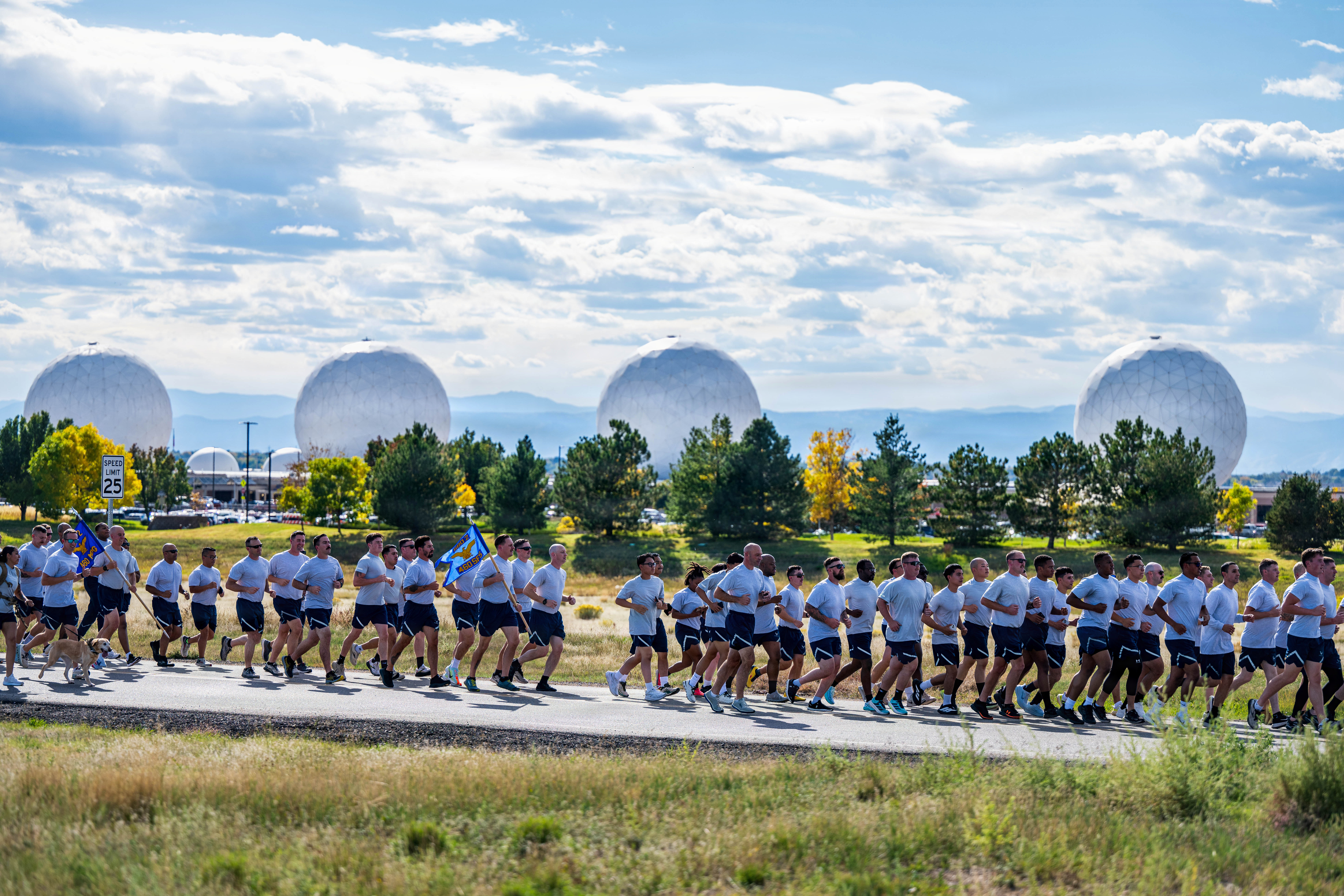
It’s such an easy question to answer. The thing I’m most proud of is the guardians. It may sound trite or like it’s just something that needs to be said, but I mean it when I say the guardians are what I’m most proud of. The people who were not intimately involved in the establishment of the service will never understand the hundreds of thousands of hours of planning, of execution, of details — details unseen that will never see the light of day. They just happened. They fixed a problem, and we moved on to the next one. But it was a monumental task to establish the service. I tell the story of being employee No. 89. Gen. [John W.] Raymond was the first CSO, kind of employee No. 1. And he hired a chief master sergeant of the Space Force, Toby Towberman, right behind as employee No. 2. And then we got 86 second lieutenants from the U.S. Air Force Academy. Well, 86 second lieutenants are going to contribute the way 86 second lieutenants do. I was No. 89. Really, I was the third major employee in this effort. And to think about a service now that’s over 15,000. We put our heads down, we looked at the details, we assessed what needed to be done, we came up with a plan, and we built the service. But it was all those guardians that we’ve pulled into the service that had to do that work, and I just couldn’t be more proud of them.
What lasting impact do you hope to leave with the guardians?
I get that question [a lot]. What’s your legacy? And I’m just not somebody that’s caught up in the legacy. I’m a guy that was asked to do a job, and I’m doing it to the best of my ability. But I will say that I will be proud of the work that was done to build the foundation. Gen. Raymond did an amazing lift, just getting us across the start line. No small effort. And then CSO two had to turn that into an institution that had all the processes, all the products, the ballast in the ship, the institutional credibility to do what we needed to do. And I think we’ve done a nice job of laying those foundations. I think we’ve defined our vision. I think we’ve defined what it means to be successful for the joint force. I think we have a theory of success. I think we defined our mission. I think we talk about the functional activities that a service has to do: force design, force development, force generation, force employment. And we’ve built the key activities that underpin each of those. We’ve documented them so those com[ing] behind us can execute a repeatable process. And I think if you get the foundation right, there’s just no limits to the height the service can go. And I think we’ve done a nice job of laying the foundation. And I think the generations that come behind us will be able to leverage that to their advantage and to the advantage of the Space Force.
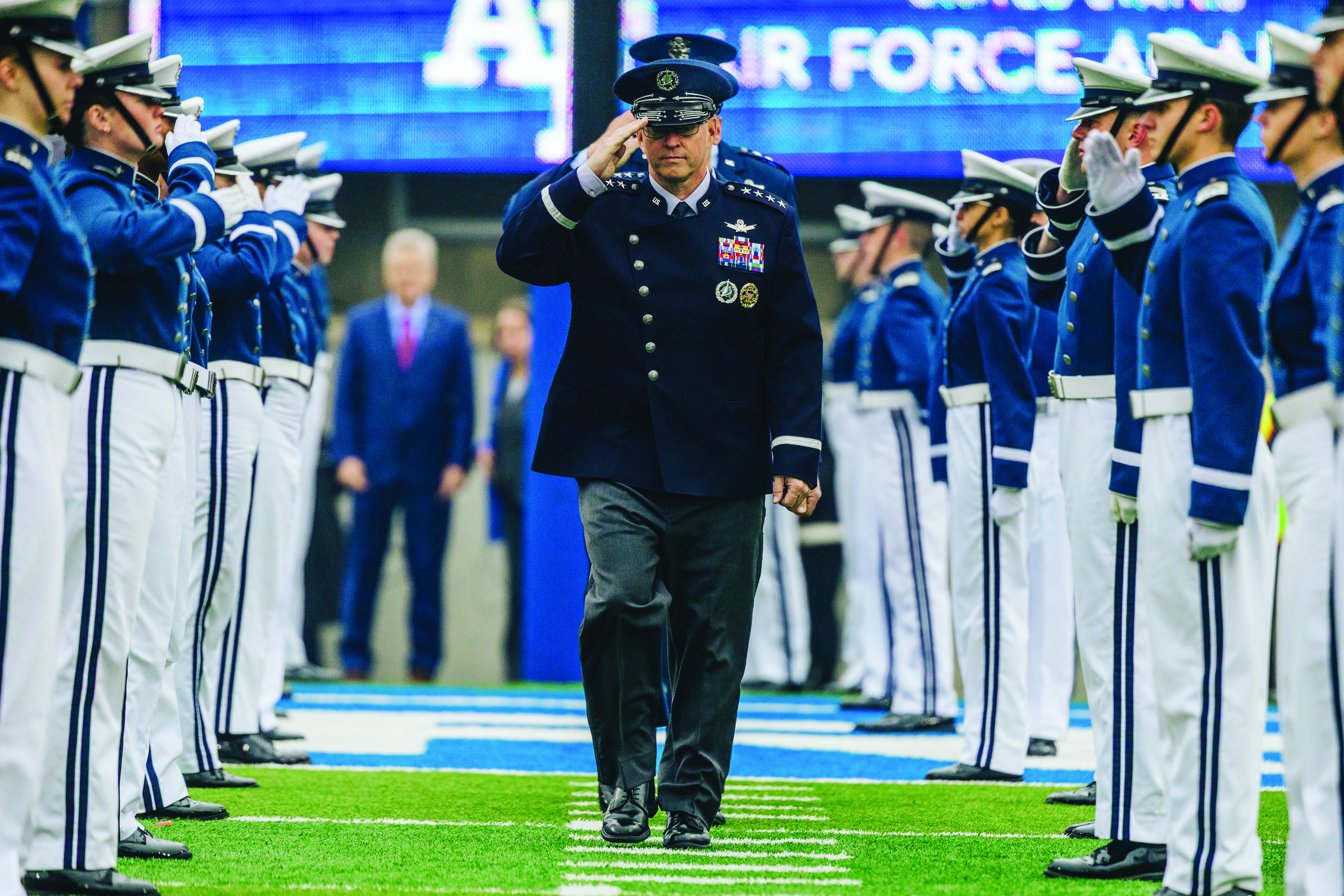
More than 570 Air Force Academy graduates have commissioned in the Space Force since 2020. How has USAFA done preparing them to lead?
There’s no question that the second lieutenants that come in have to be ready to lead from Day 1. That’s as much of a mindset as anything else because the first thing we ask them to do is get trained. And sometimes it’s not seen that there’s a lot of leadership opportunities in a training course, and that’s OK. You have to establish the credibility; you have to build your own personal foundations to be successful. But what we can’t train are the qualities and values that our officers bring to the service with them. They’re captured in our Core Values: character, commitment, connection, courage. If you don’t come with those, boy, the rest of it’s going to be really tough.
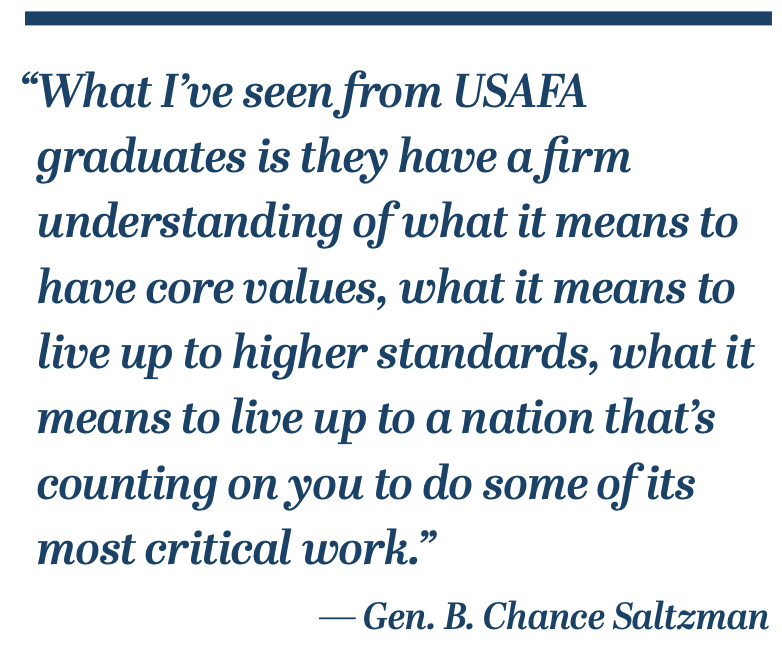
And so, what I’ve seen from USAFA graduates is they have a firm understanding of what it means to have core values, what it means to live up to higher standards, what it means to live up to a nation that’s counting on you to do some of its most critical work. And if you don’t have the character to follow through, if you don’t have the commitment to handle all the details, if you don’t connect to others and ask for help and try to learn as quickly as possible, and if you don’t have the courage to challenge your assumptions, the courage to kind of get outside of your comfort zone and discover what you could do, not just what you think you can do, you’re not going to be as successful. And I think what I’ve seen from the graduates, all of our new second lieutenants, is that they do have those values, and that they are ready on Day 1 to put them into effect and do the best they can for the Space Force.
What do you feel are the biggest challenges and threats in space that our nation and partners face today?
The biggest threats we face, again, there’s the literal challenges of our adversaries, the pacing challenges of the PRC. Right behind them is Russia. It’s certainly an acute challenge that we see in Eastern Europe. But you know, it’s not enough to just say those countries. What is it that they’re doing that really creates the kind of threats that we’re concerned about? I mentioned the six counter space categories of counter space weapons that they’re investing heavily in, the pace with which they’re doing it. But it’s also not enough just to protect our systems from those threats. The PRC has built what we call a kill web. They’ve built space-enabled targeting that really holds at risk our joint force. So if the Space Force can’t deny our adversaries the use of space, then we’re not going to be as effective as a joint force as we need to be. That is a challenge. We have to be able to disrupt, deny [and] degrade those capabilities that our adversaries want to use against us, to harm our force so that we can continue to achieve our military objectives. And that’s going to be a long, detailed — expensive in some cases — proposition, but one that we’re committed to.
What are the biggest cyber security threats facing satellite and space-based systems today?
The cyber threats are real. You cannot effectively execute space missions if you don’t have ground cyber networks to be able to downlink the data, distribute the data to fusion centers, to distribute the data to decision makers, to rapidly make sense of that information. That is all of our cyber network. If those fall prey to cyber threats, then space effects can’t be realized. It’s as simple as that. So we take very seriously the cyber mission defense of our networks, of our systems that bring these capabilities to bear. And we have focused, initially, our cyber force on the defense of our mission-critical networks. And they are laser-focused on getting that done, mapping out the cyber terrain, making sure we understand exactly what the threats are, and being ready to mitigate them in real time, so that they don’t pose the kind of threats that we see in other parts of the world.
Air Force Secretary Dr. Troy Meink cited readiness as a top concern. What are some Space Force readiness issues?
The readiness issues are like everybody else. What’s the threat? When do you need to be ready? Time, circumstance? It’s a perpetual problem because as soon as you say you’re ready, the adversary decides to do something different or in a different place. You have to be continuously ready; it’s a very dynamic process. So one of the things we focus on is how we generate our forces in the most ready, capable way. We built a model — a rotational model called Space Force Generation — where we realized that day-to-day operations of a SATCOM system or of our GPS constellation doesn’t necessarily get us ready for a highend fight. What it takes to do the data operations isn’t the same as what it will take when you’re in a contested environment. And so what we’ve done is we’ve carved out time for operators to come out of the commit phase, where they’re doing the day-to-day operations, and then focus on threat-based tactics. How are we going to overcome a threat? And so we put them in simulators, we put them on ranges, we put them against a replicated red force so that they can see the threats and they can practice against those threats. Practice gets the reps and sets of their tactics to be effective when called on. And so that model has been very important for us to make sure we’re ready for that high-end fight should it come. The second thing we’ve done is realize that employed-in-place forces have different readiness requirements than expeditionary forces.
The bases that we fight from are the power projection platforms, power, cooling air. These are vital instruments. This is like gas, if you will, to our force. And so defining the weapon-system infrastructure in a way that allows us to have transparency into what the issues are, so that we can be ready and make sure those systems are ready to support our operations. That’s another key piece. And then the last thing I’ll say is we stood up integrated mission deltas. And this may just sound like an org chart — kind of shuffling the deck chairs — but it was not. It was actually a consolidation of all the readiness elements under a lower, more subordinate commander. The colonels and lieutenant colonels in the field now have responsibility for all of the readiness elements: the people, the training, and the equipment and the sustainment of that equipment. It’s not split across field commands. It’s actually at the delta level, where they can be accountable for the full-scale readiness of their units.
How does the Space Force protect U.S. assets from anti-satellite weapons?
The U.S. Space Force has to recognize [and] understand what the threats are, first and foremost. I’ve described our theory of success in three basic tenets. First, we have to be able to avoid operational surprise. If we don’t know what’s going on and attribute bad behavior on orbit, we’re not going to be ready to mitigate threats to our capabilities. And so having the space domain awareness tools, the sensors, the equipment, the data fusion, the decision-making support [is] essential. And then we have to be able to build resilient architectures to try to make it sound like an attack against our systems will not work; it’ll be self-defeating. And if our systems are resilient to that attack, we think we can deny that first-mover advantage that might come if you are more vulnerable. So we’re proliferating our constellations. Instead of having six satellites responsible for a mission, there might be hundreds of satellites, creating a targeting problem for the adversary. That makes us more resilient and starts to deny attacks to an adversary. Those are the basic ways that we’re trying to make sure that we understand what the threats are and mitigate the threats as quickly as possible. The goal, of course, is deterrence, so that an adversary takes a look, realizes they’re not going to get away with it, and they probably won’t achieve the mission effects they’re trying to achieve, so it’s probably not worth attacking at all.
What does “defending U.S. satellites from would-be assailants” look like in practice?
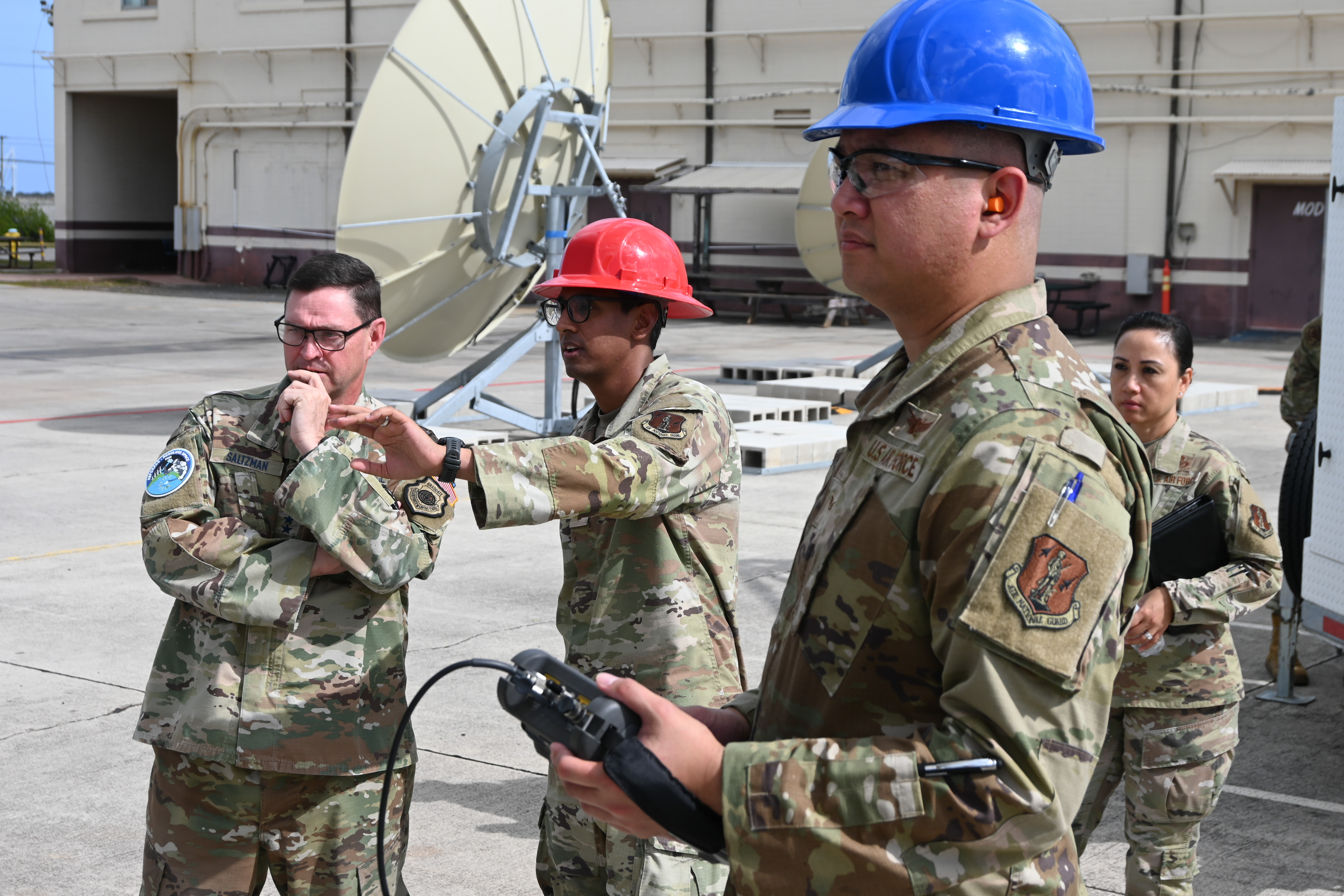
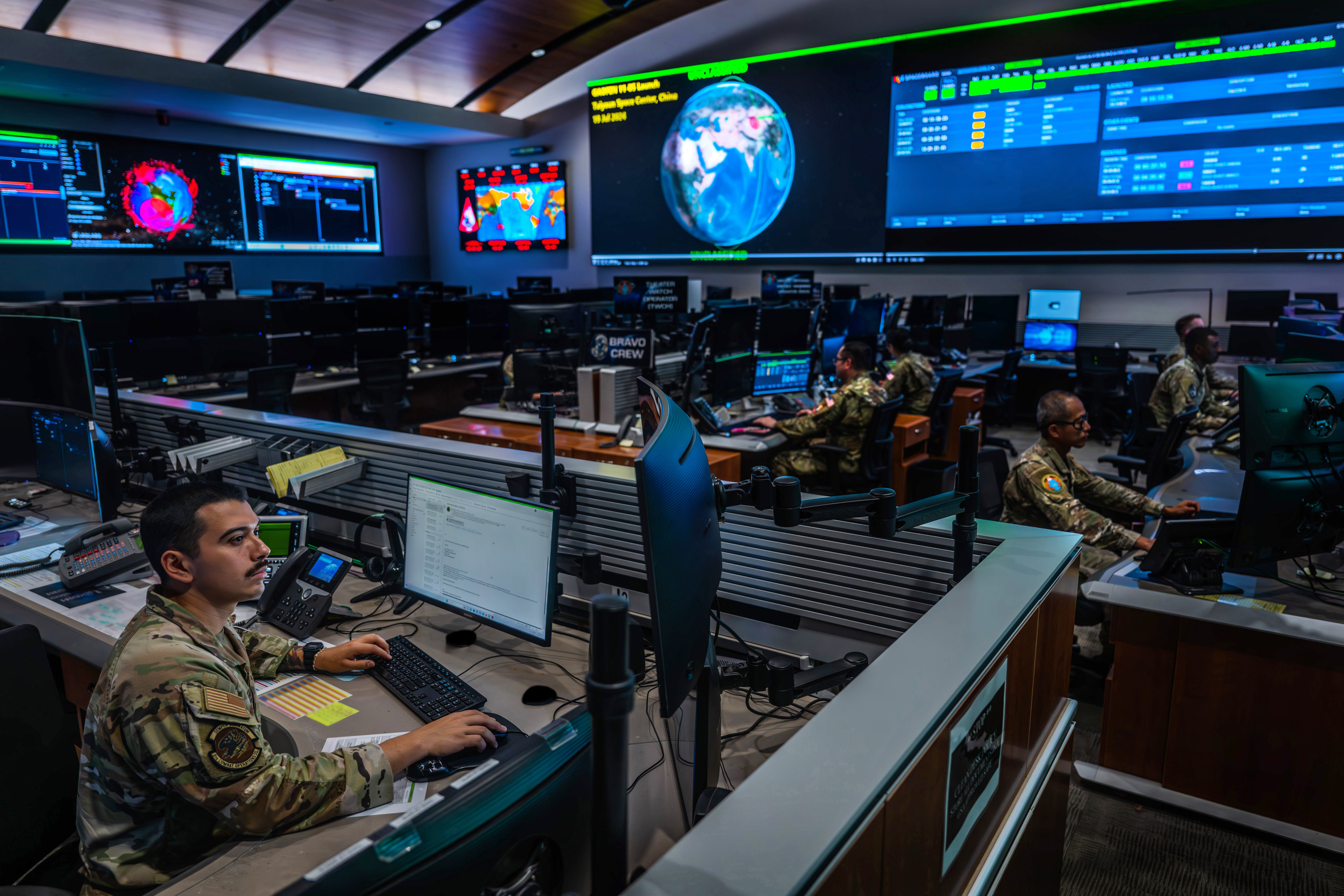
The actual work of defending our assets on orbit starts with understanding the environment. We have sensors that are positioned globally. We have operators that task those sensors to make sure that we’re tracking almost 25,000 objects that are on orbit that we’re paying attention to, and another 40,000 objects, when you start thinking about the debris and things like that. So we have to understand the threats man-made threats, as well as adversary threats. We have to see those in real time. So you have to do the analysis — continual analysis — to make sure you’re ready for it and then characterize the orbits of these things as they shift and move. So if an adversary is trying to maneuver so we can’t find out where it is on orbit, how fast can we determine what the new orbit is? So we have operators, again at our operations centers that are pulling this data in, doing the analytical work and making sure that we have a good picture of what’s on orbit and what the behaviors are and what’s happening activity-wise in space. That’s a big part of defense. And then second is understanding what the current environment looks like, so you can rapidly identify if there is aggressive, irresponsible behavior. Is there a launch that could threaten? We’re always watching for launches. Is there RF [radio frequency] jamming on orbit? What are the indications? Rapidly seeing them, trying to mitigate those effects. And so constantly being on watch is what it really looks like. Operations centers are 24/7, every day of the week, every minute of the day, watching, trying to make sure they understand how the systems are operating. And if there’s any adversaries trying to deny those effects, that we can respond to them.
Anything else that Checkpoints readers should know or that you want to share about the Space Force?
I would summarize by saying we’re at our sixth birthday, which is still pretty junior by all accounts when you have services that have been around a couple of centuries. The Air Force has more decades under its belt than the Space Force has years under its belt. But I’m really proud of the progress we’ve made. I feel like we do have a very capable service that’s not just establishing itself in the Department of Defense, in the joint force, but it’s continuing, and has continued to do the day-to-day missions. We still provide GPS signal every single day. We’re still providing satellite communications and missile warning and nuclear commandand-control capabilities. It’s all happening seamlessly while we continue to develop ourselves and the other missions. And so we’re still a little bit of a work in progress. I don’t want anybody to think you’re done, like we’ve got everything established. We’re looking for more resources. We’re looking for more people. We’re continuing to refine based on the lessons that we’ve learned, and this will be an ongoing process for a while. But while we’re still somewhat establishing, I’m really happy with the foundation that we’ve built. I think we’re in a good place to continue to perform those missions and even acquire new ones, and I’m really excited about the future of the Space Force and the guardians who are joining it.